
The Laboratory
VertiLab is Italy’s first testing laboratory accredited according to UNI CEI EN ISO/IEC 17025:2018 for testing anchorage devices in accordance with EN 17235:2024.
VertiLab was established with the goal of providing testing and quality control services through a solid and well-organized structure, supported by state-of-the-art technologies and systems.
The laboratory is based on a proprietary and highly innovative project, developed to ensure high standards of reliability, precision, and technical expertise.
Today, VertiLab is an independent organization, led by a team of qualified and specialized professionals, capable of supporting clients with professionalism and attention at every stage of the process, from initial consultation to final validation.

Accredited Testing Laboratory UNI CEI EN ISO/IEC 17025:2018
VertiLab has obtained the accreditation according to UNI CEI EN ISO/IEC 17025, the international reference standard for the competence of testing laboratories.
The accreditation, issued by Accredia under number 02366, covers the performance of tests in accordance with the following technical standards.
- EN 795:2012 – Anchorage devices
- EN 17235:2024 – Permanent anchorage devices
- UNI 11578:2015 – Anchorage devices intended for permanent installation
Obtaining accreditation will provide further assurance of technical competence, impartiality, and reliability of test results.

Quality Management System – ISO 9001:2015
VertiLab operates under a Quality Management System certified according to UNI EN ISO 9001, ensuring structured processes, document control, traceability of activities, and continuous improvement.
ISO 9001 certification guarantees controlled organization and management of laboratory activities, from test planning to the management of technical reports.
Download the certificate issued by TÜV Rheinland Italia.

Expertise and Mission
VertiLab performs physical and mechanical testing, analysis, inspection, verification, experimentation, conformity assessment, and certification of anchorage devices and fall protection systems.
We operate with technical rigor, an engineering approach, and full attention to regulatory compliance, with the aim of supporting manufacturers, designers, and operators in verifying performance and developing safe, reliable, and innovative solutions.
The Facility
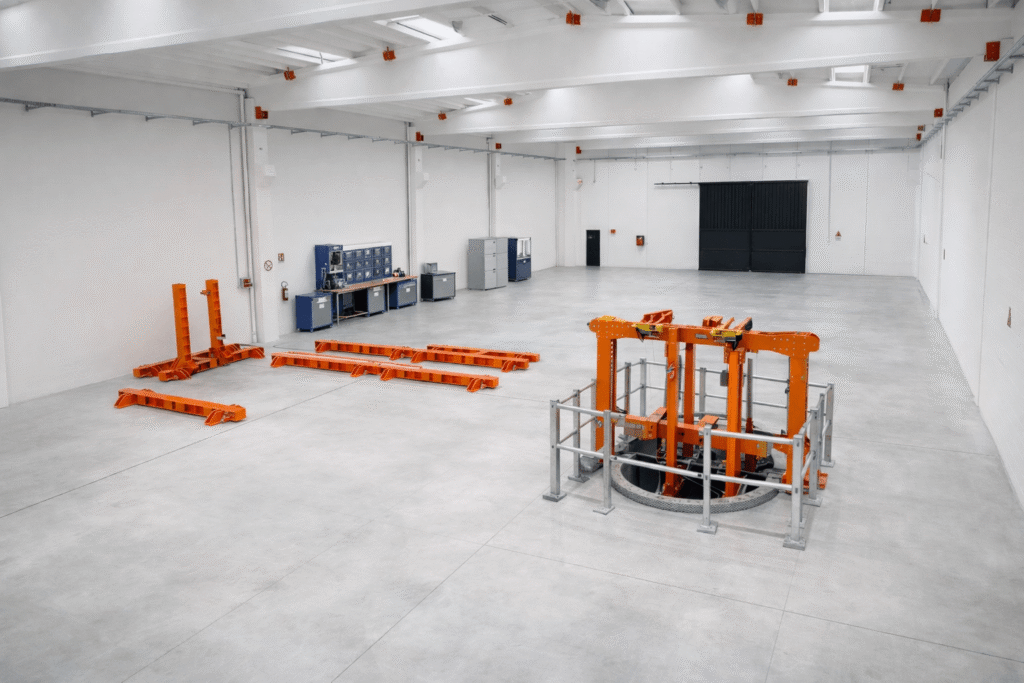
The facility extends over a covered testing area of more than 1,000 m², designed to carry out tests on various types of lifelines and anchorage systems.
It is equipped with an underground drop tower exceeding 10 meters in height, designed for the simultaneous use of multiple independent masses, and a modular support system ensuring maximum operational flexibility and adaptability to different test configurations.
The construction of the laboratory required excavation to a depth of more than 10 meters in order to create a versatile and unique testing field.
Innovation and Intellectual Property
The testing system was designed by developing solutions that ensure high quality standards while maintaining flexibility.
While maintaining a more versatile ground-level installation, the underground drop tower configuration reduces the number of deviations compared to above-ground tower systems, limiting the effects introduced by friction, deflections, and variable geometries.
This approach ensures more stable, repeatable, and comparable test conditions over time, guaranteeing the reliability of results.
Advantages
Repeatability and Control
The testing system has been designed to ensure maximum repeatability of results and control of measurement variability.
Repeatability is not only a typical requirement for testing laboratories; it cannot be taken for granted.
Some standards evaluate sample performance by penalizing statistical dispersion of results.
An infrastructure designed to minimize sources of uncertainty and variability—both during load application and response parameter measurement—reduces statistical dispersion due to different test configurations.
This allows for reduced statistical dispersion thanks to:
- control of testing conditions
- minimization of sources of uncertainty
- greater stability of measurements
- better comparability of results over time